




Generative AI Testing Tools and the Coverage Compounding Effect
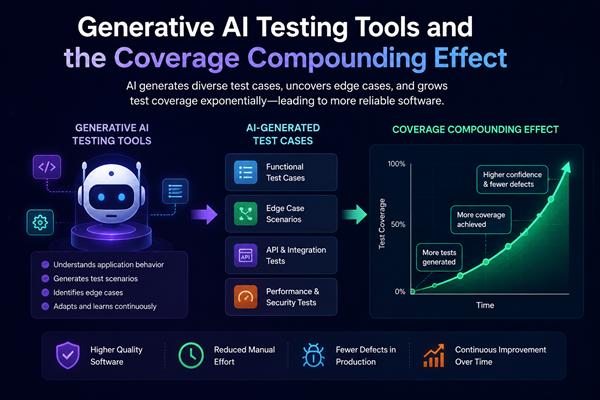
Coverage in manually maintained test suites grows linearly at best. Each new endpoint requires someone to allocate time to write tests for it. The time required per endpoint is roughly constant, which means coverage grows in proportion to the time invested in test writing. When the team's velocity is high and the API surface is expanding faster than the available testing time, coverage gaps accumulate predictably.
The compounding effect that changes this dynamic is unique to generation-based approaches and worth understanding precisely, because it's the mechanism that makes the coverage economics genuinely different rather than marginally better.
How Traffic-Based Coverage Compounds
When generative AI testing tools generate coverage from real traffic rather than from manual test writing, the coverage growth rate changes character. Each new scenario that real users encounter in staging or production becomes a potential test case. The more varied the traffic, the more varied the coverage.
The compounding happens because real users explore the application in combinations and sequences that developers don't think to test. A user who creates a resource, modifies it, deletes part of it, and then queries the result exercises the API in a sequence that nobody wrote a test for. When this sequence gets recorded and turned into a test case, coverage expands without anyone having planned for that expansion.
The Traffic Diversity Flywheel
As the application handles more users, the traffic becomes more diverse. More diverse traffic produces more varied test cases. More varied test cases catch a broader range of regressions. This is a flywheel that doesn't exist in manually written test suites, where coverage is bounded by what developers thought to test rather than by what users actually do.
The AI testing tools category that benefits most from this flywheel is the behavior-based generation category. Tools that observe and record rather than predict and generate become more valuable as the application matures, because the traffic base they draw from grows richer over time.
Where the Compounding Breaks Down
The compounding effect depends on traffic that reaches the recording layer. Features behind feature flags that haven't been enabled for real traffic. Endpoints that are only exercised by a single internal workflow. Error paths that only occur under specific failure conditions. These coverage areas don't benefit from the flywheel because the traffic that would exercise them doesn't reach the recorder.
The practical mitigation is explicit coverage of known gaps alongside traffic-based coverage of common patterns. Test scenarios for the known infrequently-triggered flows get recorded manually. Traffic-based generation covers the rest. Together they produce coverage that's both comprehensive for the common cases and intentional for the known edge cases.
Comparing the Growth Curves
A team starting with manual test writing and a team starting with traffic-based generation have similar coverage at week one, because neither has had time to accumulate much of either. At month six, the divergence is visible. The manual team has coverage proportional to the test writing time invested. The traffic-based team has coverage proportional to the traffic variety the application has seen. At month eighteen, the gap is typically large enough to be the deciding factor in how confident the team is in any given deployment.