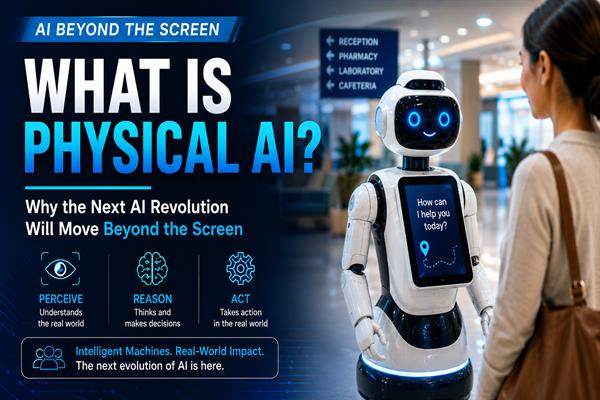




What is Physical AI? Why the Next AI Revolution Will Move Beyond the Screen
For the past few years, Artificial Intelligence has largely been experienced through screens.
We ask ChatGPT to answer questions, generate code, summarize documents, or help us write emails. Image generation models create artwork from text prompts. AI copilots assist developers while writing software. Businesses use AI to analyze data and automate workflows.
These innovations have fundamentally changed how we work.
But they all have one thing in common.
They live inside software.
Now imagine something different.
Imagine walking into a hospital where an intelligent robot welcomes you, understands your spoken language, guides you to the correct department, answers your questions, and even assists the staff with routine tasks.
Or consider a university campus where a robotic assistant helps new students navigate buildings, provides admission information, and responds naturally to questions.
What if warehouses, hotels, airports, shopping malls, and manufacturing facilities all had intelligent machines capable of perceiving their surroundings and making real-time decisions?
This is not science fiction anymore.
It is the beginning of Physical AI.
Unlike traditional AI systems that remain inside applications, Physical AI enables intelligent systems to perceive the real world, reason about what they observe, and take meaningful actions.
As someone who has spent more than 15 years working in enterprise technology and now contributes to AI-powered robotics as a Senior Product Manager at Alphadroid, I've come to realize that the next wave of AI isn't just about creating better conversations. It's about enabling intelligent systems to collaborate with people in the physical world.
This shift represents one of the biggest technological transitions since the rise of the internet.
What is Physical AI?
At its core, Physical AI is the combination of Artificial Intelligence and robotics that allows machines to understand and interact with the physical world.
Unlike Generative AI, which produces digital outputs such as text, images, code, or audio, Physical AI focuses on intelligent actions.
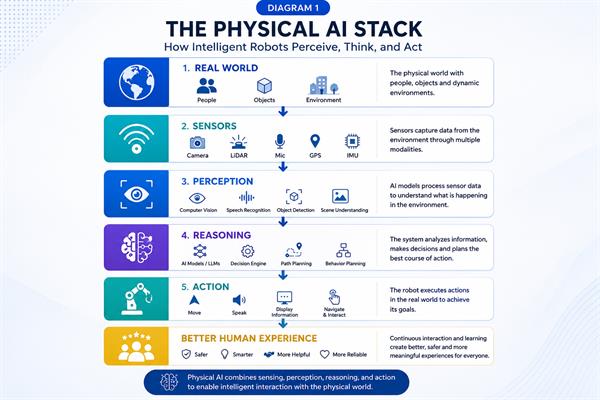
A Physical AI system typically performs three fundamental tasks:
- Perception
The system gathers information from its environment.
This may include:
- Cameras
- LiDAR
- Depth sensors
- Microphones
- GPS
- Temperature sensors
- Motion sensors
Just as humans use eyes and ears to understand the world, robots rely on sensors to perceive their surroundings.
- Reasoning
Once information is collected, AI models analyze it.
The robot determines questions such as:
- Where am I?
- Who is standing in front of me?
- Is someone blocking my path?
- Which direction should I move?
- What did the person ask me?
This reasoning combines machine learning, computer vision, language models, and decision-making algorithms.
- Action
Finally, the robot performs an action.
It may:
- Move toward a destination
- Speak with a visitor
- Open a door
- Deliver supplies
- Display information
- Avoid obstacles
- Notify a staff member
This ability to observe, think, and act is what separates Physical AI from traditional software applications.
Why Now?
Many people ask:
"If robotics has existed for decades, why is everyone suddenly talking about Physical AI?"
The answer lies in the convergence of several technological breakthroughs.
- Over the last five years, advances in AI have accelerated dramatically.
- Large Language Models have made conversations more natural.
- Computer Vision has become significantly more accurate.
- Sensors are more affordable than ever.
- Cloud computing enables massive AI workloads.
- Edge computing allows decisions to happen in milliseconds.
- Battery technology has improved.
- Robotics hardware has become more reliable and cost-effective.
- Individually, these innovations are important.
- Together, they create the perfect foundation for intelligent autonomous systems.
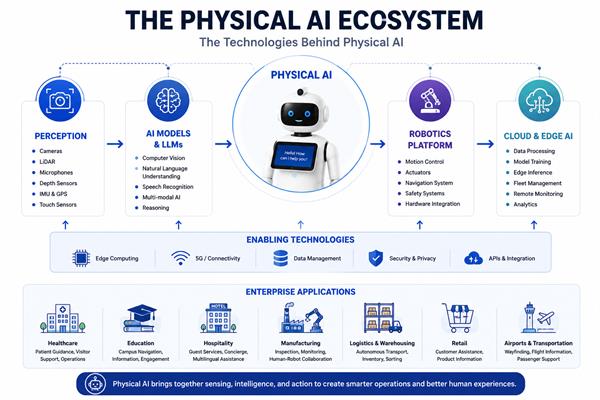
For the first time, robots can understand human language, interpret visual environments, make informed decisions, and continuously learn from experience.
That is why many industry experts believe we are entering the era of Physical AI.
Generative AI vs Physical AI
One of the biggest misconceptions is that Physical AI is simply ChatGPT inside a robot.
It isn't.
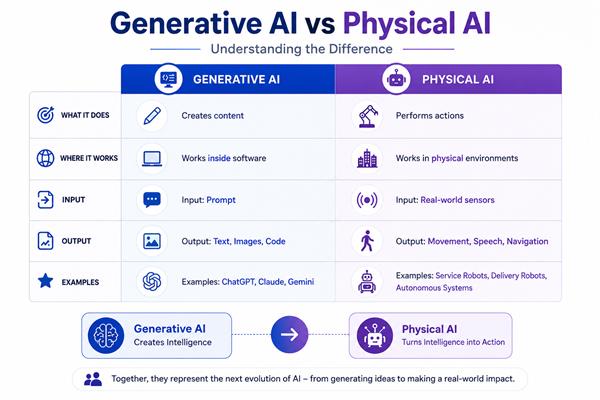
Generative AI focuses on creating digital content.
Physical AI focuses on interacting with the real world.
|
Generative AI |
Physical AI |
|
Generates text, images, audio, and code |
Performs physical tasks |
|
Lives inside software |
Operates in physical environments |
|
Responds to prompts |
Responds to real-world events |
|
Uses documents and datasets |
Uses sensors, cameras, and environmental data |
|
Creates answers |
Takes actions |
Think about ChatGPT.
It can explain how to navigate a hospital.
A Physical AI robot can actually guide you there.
That distinction is what makes Physical AI so exciting.
Intelligence Is No Longer Enough
For years, AI has been measured by how well it answers questions.
But real-world environments demand much more than intelligence.
Imagine a hospital lobby during peak hours.
Visitors arrive with different needs. Some are anxious. Others may not speak the local language. Wheelchairs are moving through the corridor. Staff members are assisting patients. Elevators are busy.
An intelligent robot operating in this environment must do far more than answer a question correctly.
It must recognize people, understand speech despite background noise, navigate safely, avoid obstacles, adapt to changing conditions, and communicate naturally.
In other words, it must combine perception, reasoning, and action in real time.
That is the true promise of Physical AI.
The Technology Behind Physical AI
If perception, reasoning, and action are the three core capabilities of Physical AI, then a natural question follows:
How does a robot actually achieve them?
Unlike traditional software, which relies primarily on data and algorithms, Physical AI combines multiple technologies that work together to create intelligent behavior. Think of it as an orchestra where every component plays a different role. A robot is only as capable as the coordination between these technologies.
Computer Vision: Giving Robots the Ability to See
The first step in interacting with the physical world is understanding it.
Computer Vision enables robots to interpret visual information captured through cameras. Instead of simply recording images, AI models identify objects, recognize people, estimate distances, detect movement, read signs, and understand scenes.
Imagine a robot placed in the reception area of a hospital. As visitors arrive, it must determine whether someone is approaching, identify the location of entrances and elevators, and recognize if its path is blocked. All of this depends on Computer Vision.
Modern vision models can also recognize gestures, detect facial expressions, and understand contextual information. While these capabilities continue to improve, the real value comes from using them responsibly to enhance user experiences rather than replacing human interaction.
Sensors: Understanding the Environment Beyond Vision
Humans rely on more than sight to navigate the world, and so do intelligent robots.
Physical AI systems often combine information from several sensors, including:
- RGB cameras for visual input.
- Depth cameras to estimate distances.
- LiDAR to create detailed maps of surroundings.
- Ultrasonic sensors for obstacle detection.
- Inertial Measurement Units (IMUs) to measure movement and orientation.
- Microphones for voice interaction.
- Touch and proximity sensors for safe human interaction.
Each sensor contributes a different piece of information. Together, they provide a more complete understanding of the environment, allowing the robot to make better decisions.
SLAM: Helping Robots Know Where They Are
One of the biggest challenges in robotics is localization.
How does a robot know its current position inside a large building where GPS may not work?
The answer is Simultaneous Localization and Mapping (SLAM).
SLAM allows a robot to build a map of an unfamiliar environment while simultaneously determining its own location within that map. As the robot moves through corridors, turns corners, or encounters new obstacles, it continuously updates both the map and its understanding of where it is.
This capability is fundamental for autonomous navigation in hospitals, universities, warehouses, hotels, airports, and many other indoor environments.
Without SLAM, a robot could easily lose its orientation or fail to adapt when the environment changes.
Artificial Intelligence: From Data to Decisions
Collecting information is only part of the challenge.
The real intelligence lies in deciding what to do next.
Machine learning models analyze data from cameras and sensors to identify patterns, understand situations, and determine the most appropriate action.
For example, if a visitor asks for directions to a cardiology department, the robot must:
- Interpret the spoken request.
- Understand the destination.
- Determine the current location.
- Plan an appropriate route.
- Monitor the path for unexpected obstacles.
- Adjust the route if necessary.
- Continue interacting naturally throughout the journey.
These decisions happen continuously, often within fractions of a second.
Large Language Models: Making Conversations Natural
Recent advances in Large Language Models (LLMs) have transformed how people interact with intelligent systems.
Instead of relying on rigid command structures, users can now speak naturally.
A visitor might say:
"I'm looking for the pediatric department. Can you help me?"
Rather than matching a fixed keyword, an LLM understands the intent behind the request and generates an appropriate response.
In Physical AI, language models become even more valuable because they are combined with perception and action. The robot doesn't simply answer a question. It can also guide the visitor, display relevant information, or notify staff if additional assistance is needed.
Natural language interaction helps make technology more accessible, particularly for people who may not be comfortable using traditional interfaces.
Edge AI and Cloud AI: Finding the Right Balance
Not every decision should depend on an internet connection.
Some tasks, such as obstacle avoidance or emergency stopping, require immediate responses and are typically processed on the device itself using Edge AI.
Other tasks, such as analyzing large datasets or updating AI models, can be handled efficiently in the cloud.
The most effective Physical AI systems often combine both approaches. Critical decisions happen locally for speed and reliability, while cloud services provide additional intelligence, updates, and long-term learning.
Physical AI in Action
While the technology is fascinating, its true value becomes clear when applied to real-world problems.
Across industries, organizations are exploring how intelligent robotic systems can improve efficiency, enhance customer experiences, and support employees rather than replace them.
Healthcare
Healthcare environments are often complex and fast-paced. Staff members manage clinical responsibilities while also assisting visitors with directions and routine questions.
Physical AI can help by providing navigation assistance, answering frequently asked questions, supporting visitor guidance, and handling repetitive interactions, allowing healthcare professionals to focus more on patient care.
Through my work at Alphadroid, one thing has become increasingly clear: successful healthcare technology isn't about replacing people. It's about reducing friction in everyday experiences so that patients, visitors, and staff can focus on what matters most.
Education
Large campuses can be overwhelming for new students and visitors.
Intelligent assistants can provide campus navigation, admission guidance, event information, and visitor support, creating a more connected and accessible environment.
Hospitality
Hotels continually look for ways to improve guest experiences while maintaining operational efficiency.
Physical AI can assist with guest guidance, concierge services, multilingual communication, and information delivery, helping staff deliver faster and more consistent service.
Manufacturing and Logistics
Warehouses and production facilities require constant movement of materials and equipment.
Autonomous systems can assist with transportation, inventory support, inspection, and routine monitoring, allowing human workers to focus on higher-value activities.
Challenges on the Road to Physical AI
The progress of Physical AI is exciting, but deploying intelligent systems in the real world is far more challenging than building software.
Unlike digital applications, robots operate in environments that are dynamic, unpredictable, and constantly changing. Every interaction involves variables that software alone cannot fully control.
To realize the full potential of Physical AI, organizations must address several important challenges.
Reliability in Unpredictable Environments
Software operates in relatively controlled conditions. A robot does not.
A hospital corridor that is clear one minute may become crowded the next. A delivery route may be blocked unexpectedly. Furniture may be rearranged, or a group of people may gather where the robot previously navigated with ease.
Physical AI systems must continuously observe, adapt, and make safe decisions without disrupting people or operations. Building that level of reliability requires robust engineering, continuous testing, and thoughtful product design.
Safety Comes First
When AI interacts with people in physical spaces, safety is no longer just a feature. It becomes the foundation of the entire system.
Every movement, decision, and interaction must prioritize human well-being. Robots should be designed to navigate carefully, recognize obstacles, respond appropriately to unexpected situations, and provide a comfortable experience for the people around them.
For organizations adopting Physical AI, earning user trust is just as important as demonstrating technical capability.
Human Acceptance
Technology succeeds only when people choose to use it.
Introducing robots into workplaces, hospitals, schools, or public spaces often raises understandable questions.
Will robots replace jobs?
Can they be trusted?
Will interacting with them feel natural?
In many cases, the answer lies in thoughtful design. The goal of Physical AI should not be to replace people but to assist them by handling repetitive tasks, providing timely information, and improving overall efficiency.
The most successful deployments are those where humans and intelligent machines work together, each contributing their unique strengths.
Privacy and Responsible AI
Physical AI systems frequently rely on cameras, microphones, and other sensors to understand their surroundings.
This makes responsible data handling essential.
Organizations must ensure that data is collected only when necessary, stored securely, and used transparently. Compliance with privacy regulations, clear governance policies, and ethical AI practices should be considered from the earliest stages of product development rather than being added later.
Building intelligent systems also means building responsible ones.
The Future of Physical AI
We are still in the early stages of this journey.
Today's robots are becoming increasingly capable of understanding speech, navigating complex environments, and assisting people with everyday tasks.
The next generation of Physical AI will go even further.
Imagine hospitals where intelligent assistants help streamline patient journeys. Universities where students receive personalized guidance across campus. Hotels where multilingual AI concierges improve guest experiences. Manufacturing facilities where autonomous systems collaborate safely with workers to increase productivity.
The future isn't about robots replacing humans. It's about creating intelligent systems that augment human capabilities and allow people to focus on work that requires empathy, creativity, and critical thinking.
As AI continues to evolve, we will also see closer integration between language models, computer vision, robotics, and edge computing. These technologies will no longer exist as separate innovations but as parts of a unified intelligent ecosystem.
For product leaders, engineers, and businesses, the opportunity lies not in adopting AI for its own sake, but in identifying real problems where Physical AI can deliver measurable value.
Final Thoughts
For the past decade, much of the conversation around AI has focused on what machines can say.
The next decade will be defined by what intelligent systems can do.
Physical AI represents a shift from digital intelligence to real-world intelligence. It combines perception, reasoning, and action to help solve practical challenges across industries.
Working in the field of AI-powered robotics has reinforced one important lesson for me: successful innovation is rarely about creating the most advanced technology. It is about building solutions that improve everyday experiences, solve meaningful problems, and earn the trust of the people who use them.
This is why I believe Physical AI is more than another technology trend. It is the next step in the evolution of intelligent systems, where AI moves beyond screens and begins collaborating with us in the environments where we live, work, learn, and receive care.
The journey has only just begun, and I'm excited to be part of an industry that is helping shape what comes next.
What's Next in This Series
In the next article, we'll explore "Generative AI vs. Physical AI: Understanding the Difference."
We'll compare how these two branches of AI complement each other, where each excels, and why the future of intelligent systems will likely combine the strengths of both.