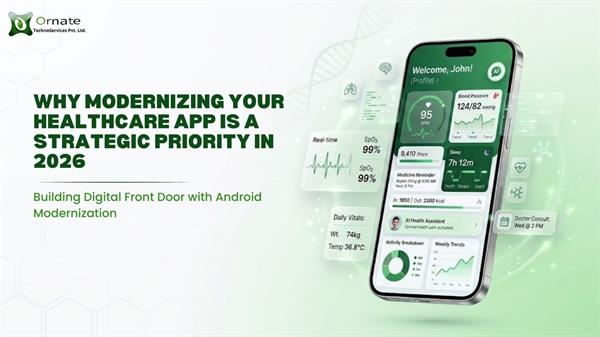




Why Healthcare Compliance and Professional UI UX Services Matter in 2026

The healthcare landscape in May 2026 is at a strategic crossroads. While the HHS Digital Accessibility Deadline has been extended to May 11, 2027. Healthcare leaders now have a twelve-month window to ensure their mobile platforms meet WCAG 2.1 AA standards or face significant federal penalties and civil litigation in the coming year.
We believe that a healthcare app should never be a barrier to care. Whether it is an elderly patient struggling with font sizes, chaos designs, a burnt-out clinician navigating, or a cluttered dashboard. The friction in this digital ecosystem is a direct threat to your patient outcomes and your 2027 legal compliance.
The Architecture of Inclusive Care
To solve these systemic pressures, we focus on two core technical disciplines that work in perfect harmony:
- App Development (The Resilient Foundation)
In 2026, Android app development for healthcare is about building a secure, future-proof bridge. We develop apps that serve as a "Universal Health Hub," capable of pulling data from the USD 168 Billion IoMT (Internet of Medical Things) market and presenting it in a way that is stable, secure, and ready for the 2027 regulatory environment.
- Professional UI UX (The Compassionate Interface)
If the code is the skeleton, Professional UI UX services are the bedside manner. We specialize in "Accessibility-First" design. This means creating interfaces that adapt according to the user, whether that’s a doctor who needs a "Zero-Distraction" view during a long shift or an elderly patient who requires voice-activated navigation and high-contrast visuals.
Healthcare 2026: The Compliance & Retention
To help leadership justify the shift from "Maintenance" to "Modernization," we track these critical 2026 benchmarks:
- The 2027 Compliance Window: With the HHS extension to May 11, 2027, now is the time for a "Compliance Head-Start." Proactive modernization prevents the 2027 developer rush and ensures your app is tested and ready long before the deadline.
- The Burnout Cost: 62% of clinicians cite poorly designed interfaces as a primary driver of burnout. Optimizing the UX of a clinical dashboard can save a hospital an estimated INR 45 Lakh per year in turnover-related costs.
- The Telehealth Drop-Off: Despite market maturity, 40% of patients still drop off during the app-based onboarding process. Simplified UI can increase "first physical visit success" with clean and intuitive designs by up to 35%.
- The Wearable Gap: While patients love their wearables, 70% of doctors ignore this data because it is "too noisy." We use UI filters to turn thousands of data points into a single, readable trend line.
Solving the Pain Point: Digital Exclusion
The healthcare story today is about Heavily designed Interface. When an app is hard to use, anyone stops using it, and no healthcare professional realizes it.
This is where Ornate TechnoServices, as a specialised firm, bridges the gap between cold clinical data and compassionate care by engineering Android environments that rank human psychology over technical complexity.
We combine great coding with a "Human-First" approach. This helps us address the five main pain points of 2026:
- Ending Telehealth Drop-Off: We use Professional UI UX services to create "One-Tap" journeys, ensuring patients stay in the ecosystem from login to consultation.
- Strategic Accessibility (WCAG 2.1): We build Android apps that support dynamic font scaling and screen-reader compatibility today, so you are fully compliant before the 2027 mandate.
- Reducing Clinical Fatigue: We design "Cognitive-Load Balanced" dashboards for doctors, showing only vital information to reduce the mental exhaustion that leads to medical errors.
- Wearable Integration: Our Android app development ensures data from smartwatches is no longer "fragmented," syncing it directly into a unified, physician-friendly patient profile.
- Adherence Through Design: We build proactive interfaces that use gentle Android notifications to improve medication adherence, turning the app into a digital health coach.
Our Strategy For Modern Healthcare
- Readiness Audit: We assess your current app against the 2027 HHS accessibility mandates to identify future legal risks.
- Friction Mapping: We track where patients are dropping off in your telehealth journey and redesign those specific screens.
- Core Android Update: We migrate legacy code to modern standards to ensure stability across all patient devices.
- Interoperability Sync: We create secure pathways for wearable data to flow into your central system without overwhelming clinicians.
- Continuous Compliance: We install "Patient-Voice" analytics to ensure the app stays compliant as accessibility standards evolve toward 2027.
Conclusion
In 2026, the quality of your digital interface is just as important as the quality of your clinical care. With the 2027 HHS deadline approaching, a healthcare provider with a broken or non-compliant app is a provider that is losing patients and inviting risk.
By choosing to modernize your mobile infrastructure now, you aren't just "updating an app." You are ensuring that care is accessible, efficient, and legally sound.
At Ornate TechnoServices, we are here to help you heal the digital front door and build a healthier, more inclusive future for everyone.
Visit us at: business graphic design services
Originally posted on: Sites